Two issues, one PR, argued on #73 before starting rather than batched
silently: they are the same component and the same row of pixels — #59
removes controls from the phone's transport, #56 enlarges what is left —
and both issues already asked to be sequenced together in their own text.
Done apart, the bar gets laid out twice and the first PR ships a state
neither issue wants.
Measured at 424x439, the reference device's real viewport
The context is a property, not a media query, and that is the one
decision here. Everywhere else a component states what it drops at phone
width itself, because a media query inside a shadow root is answered by
the viewport. Here the two hosts want different answers at the same
viewport: the bar wants three controls, now-playing-view wants five,
larger still. So the host says which context and the viewport says which
size band. Sizes are --yj-control-* per context; play/pause alone goes
above the 44px floor, because a row of identical squares says every
action is equally likely and that is not true of play.
The phone draws three buttons rather than hiding two, from matchMedia (job-band's pattern). A display: none control is still
in the shadow root and still something a positional query finds, so
"the phone has three controls" would have been true of the pixels and
false of the element.
Removing a control is only allowed because it is still reachable —
plan 018's matrix promise — so the spec walks the route rather than
counting buttons. #55 merging is what makes the queue half safe: it is a
screen with a back stack now.
Four things that failed silently
Each cost a cycle, none was visible to any assertion in the repo, and
all four are in .planning/NOTES.md.
The route to Now Playing did not exist in the state that matters. now-playing renders two branches and the no-track one had no .expand button, so with nothing loaded there was no way to the
full-screen view — and once the queue button left the bar, no way to
the queue at all. The queue is persisted across restarts, so "tracks
queued, nothing playing" is a state the app launches into. Fixed
here, and pinned by a spec that clears the queue itself.
A <button> does not inherit its font from its parent — the UA
stylesheet gives it one. So a generic font-size: inherit is not the
no-op it reads as: it took every desktop button from 33x21 to 36x24.
Found only by stashing the file and measuring the baseline. The
desktop sizes are now asserted as the literal '33x21', because a
range swallows three pixels.
A rule at the bottom of index.css still loses to a nested rule
above it. The phone block is last because a media query adds no
specificity — but #queue-button is written nested inside .bottom-bar, so it builds one class more specific and a bare #queue-button { display: none } did nothing. The button simply
stayed.
The album art overflowed its own box, drawing over the header and
the title: aspect-ratio: 1 with a definite width derives a height
that nothing bounds, and 60vh bounds the viewport, not the room
left over. max-height: 100%. Pre-existing — screenshotted on main
— and found by reading a screenshot, the only tier that can see
it: nothing fails, the shell does not overflow, every control is
still hittable.
Commits
commit
issue
what
218e4f5feat(player): give the transport a context, and thumb-sized controls
phone-transport.spec.ts, openTheQueue in the fixtures
c7e5a4fdocs(player): record the phone transport, and four silent failures
—
CLAUDE.md, .planning/NOTES.md
Verification actually run
gate
result
make e2e
220 passed (whole suite)
make ui-test
974 passed (968 before; +6 from transport-context.test.ts)
tsc --noEmit in frontend/ and e2e/
clean, both
make css-check
142 files, no broken literals
make lint
0 issues, three tag sets — formality, no Go changed
make test
green, three tag sets — formality
make bindings-check / make skill-check
current / 47 targets — formalities
--project=webkit is not configured locally; check CI's WebKit step
actually ran (if: !cancelled() has silently skipped it before).
The suite is what caught this change, twice. An intermediate build
failed ten tests in four files — queue-as-a-screen, queue-overlay — none of which is about the transport: every one opened
the queue by clicking #queue-button, and so was asserting which
route exists as well as what the queue does. That is the third change in
a row where the spec I wrote was green and something else was not.
The specs bite
Reverted frontend/, rebuilt, re-ran: 5 of 10 fail, including the
reachability one. The desktop guards pass there and are meant to — they
exist to catch a change to a bar neither issue is about, which is
exactly what they did.
What is deliberately not done
#172, filed: with the transport at 172px of a 439px screen the art
is a 39px sliver. That is a consequence of #56 rather than a fault
in it. #64 (~30px) and #51 are where the space comes back. Folding
shuffle and repeat onto the primary row was considered and rejected —
it buys 52px, leaves the art at 91, and costs a third arrangement of
the same five buttons.
#64 is not touched, and a comment on it records that its first
Finding is misleading: the bar's copy is gone by width, but now-playing-view renders a volume slider that is visible on a phone,
deliberately and in writing. Platform-versus-width is the crux and the
frontend has no isAndroid signal.
Screenshots at 424x439 and 1280x800 in a comment below.
Closes #59, #56.
Two issues, one PR, argued on #73 before starting rather than batched
silently: they are the same component and the same row of pixels — #59
removes controls from the phone's transport, #56 enlarges what is left —
and both issues already asked to be sequenced together in their own text.
Done apart, the bar gets laid out twice and the first PR ships a state
neither issue wants.
## Measured at 424x439, the reference device's real viewport
| control | before | after |
|---|---|---|
| bar: shuffle / prev / play / next / repeat | **33x21** each | prev/next 44, play 56; shuffle+repeat moved |
| bar: favourite | **18x14** — smallest control in the app | 44x44 |
| bar: queue button | 33x29 | gone (#59) |
| Now Playing: all five | **33x21** each | 44, play 64 |
| **desktop bar: all five** | 33x21 | **33x21** |
## The design
**The context is a property, not a media query**, and that is the one
decision here. Everywhere else a component states what it drops at phone
width itself, because a media query inside a shadow root is answered by
the viewport. Here the two hosts want different answers at the *same*
viewport: the bar wants three controls, `now-playing-view` wants five,
larger still. So the host says which context and the viewport says which
size band. Sizes are `--yj-control-*` per context; play/pause alone goes
above the 44px floor, because a row of identical squares says every
action is equally likely and that is not true of play.
**The phone draws three buttons rather than hiding two**, from
`matchMedia` (`job-band`'s pattern). A `display: none` control is still
in the shadow root and still something a positional query finds, so
"the phone has three controls" would have been true of the pixels and
false of the element.
**Removing a control is only allowed because it is still reachable** —
plan 018's matrix promise — so the spec walks the route rather than
counting buttons. #55 merging is what makes the queue half safe: it is a
screen with a back stack now.
## Four things that failed silently
Each cost a cycle, none was visible to any assertion in the repo, and
all four are in `.planning/NOTES.md`.
1. **The route to Now Playing did not exist in the state that matters.**
`now-playing` renders two branches and the no-track one had **no
`.expand` button**, so with nothing loaded there was no way to the
full-screen view — and once the queue button left the bar, no way to
the queue at all. The queue is persisted across restarts, so "tracks
queued, nothing playing" is a state the app *launches into*. Fixed
here, and pinned by a spec that clears the queue itself.
2. **A `<button>` does not inherit its font from its parent** — the UA
stylesheet gives it one. So a generic `font-size: inherit` is not the
no-op it reads as: it took every desktop button from 33x21 to 36x24.
Found only by stashing the file and measuring the baseline. The
desktop sizes are now asserted as the literal `'33x21'`, because a
range swallows three pixels.
3. **A rule at the bottom of `index.css` still loses to a nested rule
above it.** The phone block is last because a media query adds no
specificity — but `#queue-button` is written nested inside
`.bottom-bar`, so it builds one class more specific and a bare
`#queue-button { display: none }` did nothing. The button simply
stayed.
4. **The album art overflowed its own box**, drawing over the header and
the title: `aspect-ratio: 1` with a definite width derives a height
that nothing bounds, and `60vh` bounds the *viewport*, not the room
left over. `max-height: 100%`. Pre-existing — screenshotted on `main`
— and **found by reading a screenshot**, the only tier that can see
it: nothing fails, the shell does not overflow, every control is
still hittable.
## Commits
| commit | issue | what |
|---|---|---|
| `218e4f5` `feat(player): give the transport a context, and thumb-sized controls` | #56 | the context property, the sizes, the art's `max-height` |
| `32d4dc2` `feat(player): slim the phone's mini player to three controls` | #59 | the three that leave the bar, the favourite's size, the no-track route |
| `f65822c` `test(player): pin the phone transport, and the desktop bar not moving` | #59, #56 | `phone-transport.spec.ts`, `openTheQueue` in the fixtures |
| `c7e5a4f` `docs(player): record the phone transport, and four silent failures` | — | `CLAUDE.md`, `.planning/NOTES.md` |
## Verification actually run
| gate | result |
|---|---|
| `make e2e` | **220 passed** (whole suite) |
| `make ui-test` | **974 passed** (968 before; +6 from `transport-context.test.ts`) |
| `tsc --noEmit` in `frontend/` and `e2e/` | clean, both |
| `make css-check` | 142 files, no broken literals |
| `make lint` | 0 issues, three tag sets — **formality**, no Go changed |
| `make test` | green, three tag sets — **formality** |
| `make bindings-check` / `make skill-check` | current / 47 targets — **formalities** |
`--project=webkit` is not configured locally; check CI's WebKit step
actually ran (`if: !cancelled()` has silently skipped it before).
**The suite is what caught this change, twice.** An intermediate build
failed **ten tests in four files** — `queue-as-a-screen`,
`queue-overlay` — none of which is about the transport: every one opened
the queue by clicking `#queue-button`, and so was asserting *which*
route exists as well as what the queue does. That is the third change in
a row where the spec I wrote was green and something else was not.
### The specs bite
Reverted `frontend/`, rebuilt, re-ran: **5 of 10 fail**, including the
reachability one. The desktop guards pass there and are meant to — they
exist to catch a change to a bar neither issue is about, which is
exactly what they did.
## What is deliberately not done
- **#172, filed**: with the transport at 172px of a 439px screen the art
is a **39px sliver**. That is a consequence of #56 rather than a fault
in it. #64 (~30px) and #51 are where the space comes back. Folding
shuffle and repeat onto the primary row was considered and rejected —
it buys 52px, leaves the art at 91, and costs a third arrangement of
the same five buttons.
- **#64 is not touched**, and a comment on it records that its first
Finding is misleading: the bar's copy is gone *by width*, but
`now-playing-view` renders a volume slider that is visible on a phone,
deliberately and in writing. Platform-versus-width is the crux and the
frontend has no `isAndroid` signal.
Screenshots at 424x439 and 1280x800 in a comment below.
Measured at the reference device's 424x439, every button here was
33x21px -- in the bottom bar and on the full-screen view alike. #56
reports them as "the most important thing in the mobile app and they
are tiny", and that is the number behind it.
The context is a **property, not a media query**, and that is the whole
design. Everywhere else in this app a component states what it drops at
phone width itself, because a media query inside a shadow root is
answered by the viewport and that is the honest signal. Here the two
hosts want different answers at the *same* viewport: on a phone the bar
wants three controls sized for a thumb and now-playing-view wants five,
larger still. So the host says which context and the viewport says
which size band, and neither alone can express it.
Play/pause alone goes above the 44px floor. A row of five identical
squares says every action is equally likely, which is not true of play
-- "large play/pause, adequate prev/next" is the Direction, and a spec
caught that the first version had sized all three the same.
Two things that fail silently:
The desktop bar must not move, and a `<button>` does not inherit its
font from its parent -- the UA stylesheet gives it one. So a generic
`font-size: inherit` is not the no-op it reads as: it took every
desktop control from 33x21 to 36x24. The box rules take a zero fallback
and the font-size rules are scoped to the two contexts that set one.
And the art on now-playing-view overflowed its own box, drawing over
the header above and the title below, because `aspect-ratio: 1` with a
definite width derives a height that nothing bounds -- 60vh bounds the
viewport, not the room left over. `max-height: 100%`. Pre-existing;
found by reading a screenshot, which is the only tier that can see it.
What is left is #172: with the transport at 172px of a 439px screen the
art is a 39px sliver.
Closes#56
Shuffle, repeat and the queue button leave the phone's bottom bar.
They are not gone: all three are on the full-screen Now Playing view,
one tap away through the mini player's art, which is the "reachable
only from Now Playing" this issue asks for. #55 is what makes the queue
half safe -- it is a screen with an entry in the back stack now, rather
than a panel with no way out but the button being removed here.
Removing a control is only allowed because it is still reachable, which
is plan 018's matrix promise, so that is what the spec walks rather
than counting buttons. It found that the route did not exist in the
state that matters: `now-playing` renders two branches and the no-track
one had no `.expand` button on its placeholder, so with nothing loaded
there was no way to the full-screen view at all -- and once the queue
button left the bar, no way to the queue. The queue is persisted across
restarts, so "tracks queued, nothing playing" is a state the app
launches into, not a corner.
The favourite stays on the bar and was 18x14px, the smallest control in
the app, against the 48x48 art beside it.
One CSS trap, because it failed silently. The phone block is last in
index.css on purpose -- a media query adds no specificity -- but the
rule it overrides here is written *nested* inside `.bottom-bar`, so it
builds to a descendant selector one class more specific and a bare
`#queue-button` lost to it. Being last is not enough when the thing
above is more specific.
Closes#59
Ten tests, five of which fail on the build before this. The desktop
guard is meant to pass there -- that is its job, and it is the one that
caught a three-pixel regression nothing else could see.

`openTheQueue` moves to the fixtures, because hiding one button failed
ten tests in four files about the back stack and about layout: every
one of them opened the queue by clicking `#queue-button`, and so was
quietly asserting *which* route exists as well as what the queue does.
The route differs by width now and that is the feature.

Two smaller things. The play button is named for its action, so an
exact 'Play' waits out a fixture track -- 11.1s per test, passing by
luck, and it would have failed outright against LONG_TRACK. And the
"nothing playing" case clears the queue itself rather than trusting the
app not to have played anything: `make e2e` runs one long-lived app
across every spec (#168), which is how a deterministic bug first showed
up as a flake.
The model in CLAUDE.md beside the volume rule it qualifies; the
measurements and the four things that cost a cycle each in NOTES.md,
dated. Three of the four are invisible to every assertion in the repo:
a button not inheriting its font, a nested rule out-specifying a later
one, and art whose height is bounded by nothing.
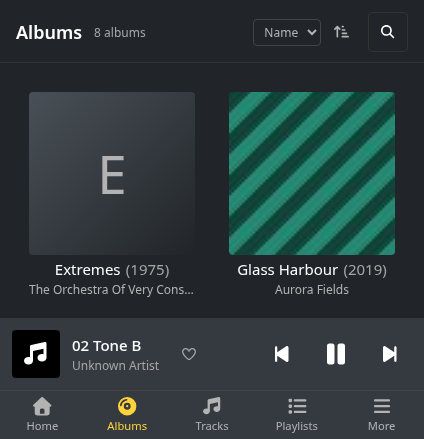
424x439 — the mini player after #59/#56. Three controls, prev/next
44px and play 56px, the favourite at 44px beside the art, no queue
button. This is what the report asked for: the transport is the thing
you can hit.
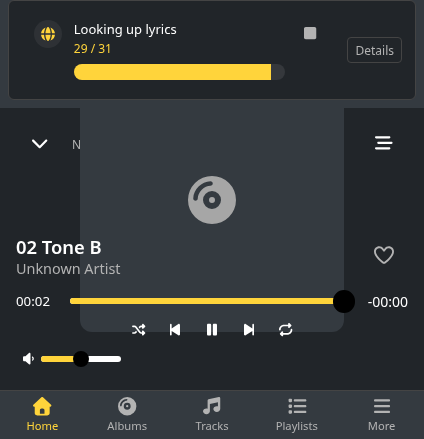
424x439 — Now Playing, before. On main. The art's height is
derived from its width and bounded by nothing, so it draws over the
header and over the title: "Looking up lyrics" is a job band, but the
disc overlapping NOW PLAYING and the text sitting behind it is the
bug. Nothing fails, nothing overflows the shell, and every control is
still hittable — which is why no tier here could see it.
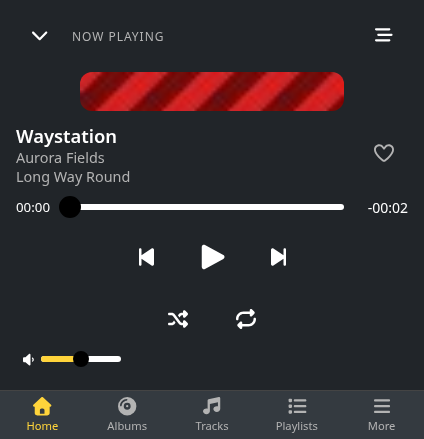
424x439 — Now Playing, after. Nothing overlaps. Five controls, play
at 64px, shuffle and repeat on their own row. And the art is a 39px
sliver, which is #172 and is stated rather than hidden: the transport
is 172px of a 439px screen, and #64 plus #51 are where that comes back.
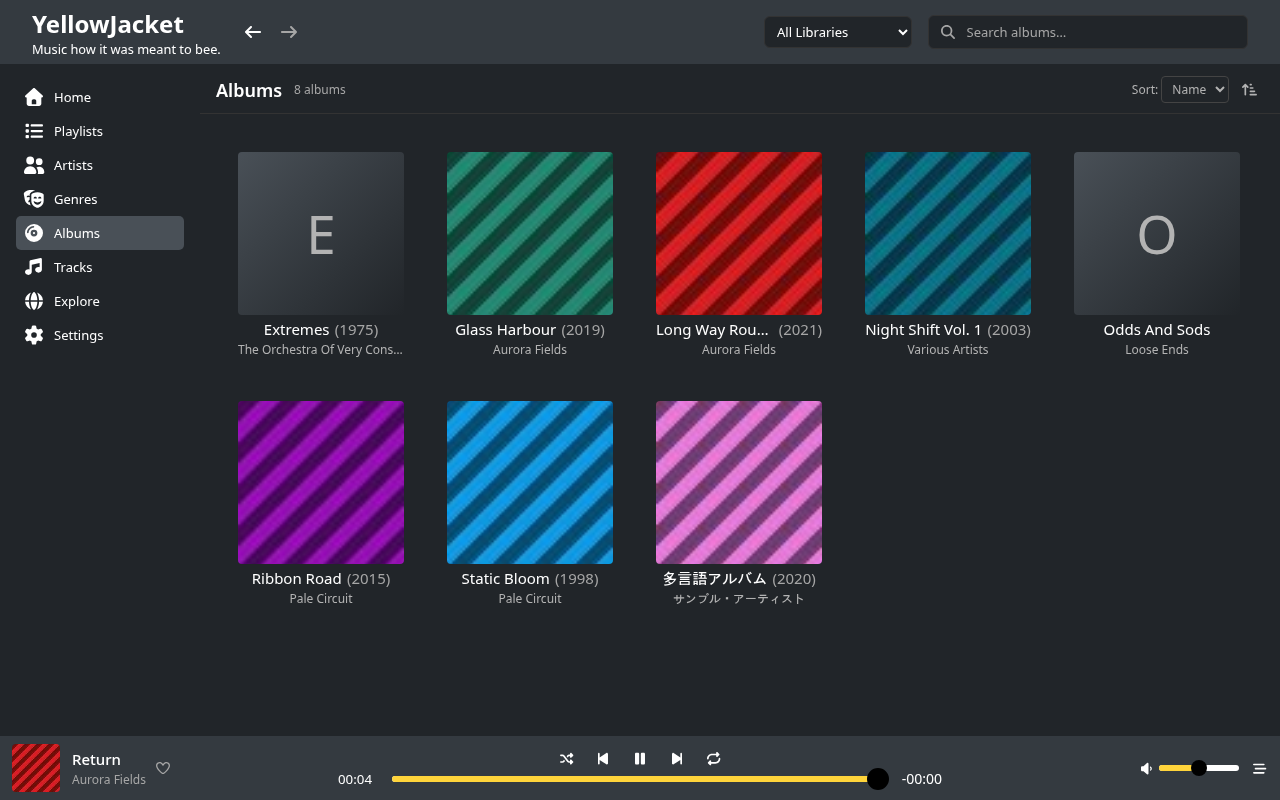
1280x800 — the desktop bar, unchanged. Five controls at 33x21, the
queue button present, the favourite at 18x14. Both issues are Platform/Android; this is asserted with a literal rather than left to
inspection.
## Screenshots
**424x439 — the mini player after #59/#56.** Three controls, prev/next
44px and play 56px, the favourite at 44px beside the art, no queue
button. This is what the report asked for: the transport is the thing
you can hit.
**424x439 — Now Playing, before.** On `main`. The art's height is
derived from its width and bounded by nothing, so it draws over the
header and over the title: "Looking up lyrics" is a job band, but the
disc overlapping `NOW PLAYING` and the text sitting behind it is the
bug. Nothing fails, nothing overflows the shell, and every control is
still hittable — which is why no tier here could see it.
**424x439 — Now Playing, after.** Nothing overlaps. Five controls, play
at 64px, shuffle and repeat on their own row. **And the art is a 39px
sliver**, which is #172 and is stated rather than hidden: the transport
is 172px of a 439px screen, and #64 plus #51 are where that comes back.
**1280x800 — the desktop bar, unchanged.** Five controls at 33x21, the
queue button present, the favourite at 18x14. Both issues are
`Platform/Android`; this is asserted with a literal rather than left to
inspection.
WebKit draws the same button 36x24 where Chromium draws 33x21, so the
literal this pinned failed in CI on a build where nothing was wrong. A
button's box comes from the UA stylesheet when the author sets nothing,
and what each UA sets is its own business.

What must not happen is that *we* set something. So: `min-width` and
`min-height` compute to 0px, the font-size still equals that of a bare
button probed in the same page, and all five boxes are identical --
which is what says the desktop is neither sized context. Checked by
re-introducing the `font-size: inherit` regression, which it catches in
Chromium; the literal form could only be checked by hand.
Run 17347: check green, E2E — webkit failed — and it failed on my
own spec rather than on the app.
[webkit] the desktop bar is untouched › keeps them exactly the size they were
  - "33x21"   (expected, measured in Chromium)
  + "36x24"   (received, WebKit)
WebKit draws the same button 36x24 where Chromium draws 33x21. A
button's box comes from the UA stylesheet when the author sets nothing,
and what each UA sets is its own business — so the literal was asserting
Chromium, not "unchanged". Nothing was wrong with the build.
Fixed in e3b64f9 by asserting the mechanism instead, which is the
same move queue-as-a-screen.spec.ts makes about containment:
min-width and min-height compute to 0px
the font-size still equals that of a bare <button> probed in the
same page — the UA's, not the shell's
all five boxes are identical, which is what says the desktop is
neither sized context
Checked that it still bites: re-introduced the font-size: inherit
regression and it fails in Chromium, naming the assertion. The literal
form could only be checked by hand, and only in one engine.
Two things worth keeping out of this, both now in .planning/NOTES.md:
an absolute pixel size is engine-specific and does not belong in an
assertion about our changes; and this is the second time in two
sessions that CI's WebKit was the only tier that could see something,
which is the argument for checking that step ran rather than trusting
the run's conclusion.
make e2e locally: 220 passed after the fix.
## CI caught something no local tier could
Run 17347: `check` green, **`E2E — webkit` failed** — and it failed on my
own spec rather than on the app.
```
[webkit] the desktop bar is untouched › keeps them exactly the size they were
- "33x21" (expected, measured in Chromium)
+ "36x24" (received, WebKit)
```
**WebKit draws the same button 36x24 where Chromium draws 33x21.** A
button's box comes from the UA stylesheet when the author sets nothing,
and what each UA sets is its own business — so the literal was asserting
Chromium, not "unchanged". Nothing was wrong with the build.
Fixed in `e3b64f9` by asserting the *mechanism* instead, which is the
same move `queue-as-a-screen.spec.ts` makes about containment:
- `min-width` and `min-height` compute to `0px`
- the font-size still equals that of a bare `<button>` probed in the
same page — the UA's, not the shell's
- all five boxes are identical, which is what says the desktop is
neither sized context
**Checked that it still bites**: re-introduced the `font-size: inherit`
regression and it fails in Chromium, naming the assertion. The literal
form could only be checked by hand, and only in one engine.
Two things worth keeping out of this, both now in `.planning/NOTES.md`:
an absolute pixel size is engine-specific and does not belong in an
assertion about *our* changes; and this is the second time in two
sessions that CI's WebKit was the only tier that could see something,
which is the argument for checking that step *ran* rather than trusting
the run's conclusion.
`make e2e` locally: **220 passed** after the fix.
logan
merged commit fd71ef53c5 into main2026-08-21 04:14:40 +00:00
Blocking a user prevents them from interacting with repositories, such as opening or commenting on pull requests or issues. Learn more about blocking a user.


Closes #59, #56.
Two issues, one PR, argued on #73 before starting rather than batched
silently: they are the same component and the same row of pixels — #59
removes controls from the phone's transport, #56 enlarges what is left —
and both issues already asked to be sequenced together in their own text.
Done apart, the bar gets laid out twice and the first PR ships a state
neither issue wants.
Measured at 424x439, the reference device's real viewport
The design
The context is a property, not a media query, and that is the one
decision here. Everywhere else a component states what it drops at phone
width itself, because a media query inside a shadow root is answered by
the viewport. Here the two hosts want different answers at the same
viewport: the bar wants three controls,
now-playing-viewwants five,larger still. So the host says which context and the viewport says which
size band. Sizes are
--yj-control-*per context; play/pause alone goesabove the 44px floor, because a row of identical squares says every
action is equally likely and that is not true of play.
The phone draws three buttons rather than hiding two, from
matchMedia(job-band's pattern). Adisplay: nonecontrol is stillin the shadow root and still something a positional query finds, so
"the phone has three controls" would have been true of the pixels and
false of the element.
Removing a control is only allowed because it is still reachable —
plan 018's matrix promise — so the spec walks the route rather than
counting buttons. #55 merging is what makes the queue half safe: it is a
screen with a back stack now.
Four things that failed silently
Each cost a cycle, none was visible to any assertion in the repo, and
all four are in
.planning/NOTES.md.now-playingrenders two branches and the no-track one had no.expandbutton, so with nothing loaded there was no way to thefull-screen view — and once the queue button left the bar, no way to
the queue at all. The queue is persisted across restarts, so "tracks
queued, nothing playing" is a state the app launches into. Fixed
here, and pinned by a spec that clears the queue itself.
<button>does not inherit its font from its parent — the UAstylesheet gives it one. So a generic
font-size: inheritis not theno-op it reads as: it took every desktop button from 33x21 to 36x24.
Found only by stashing the file and measuring the baseline. The
desktop sizes are now asserted as the literal
'33x21', because arange swallows three pixels.
index.cssstill loses to a nested ruleabove it. The phone block is last because a media query adds no
specificity — but
#queue-buttonis written nested inside.bottom-bar, so it builds one class more specific and a bare#queue-button { display: none }did nothing. The button simplystayed.
the title:
aspect-ratio: 1with a definite width derives a heightthat nothing bounds, and
60vhbounds the viewport, not the roomleft over.
max-height: 100%. Pre-existing — screenshotted onmain— and found by reading a screenshot, the only tier that can see
it: nothing fails, the shell does not overflow, every control is
still hittable.
Commits
218e4f5feat(player): give the transport a context, and thumb-sized controlsmax-height32d4dc2feat(player): slim the phone's mini player to three controlsf65822ctest(player): pin the phone transport, and the desktop bar not movingphone-transport.spec.ts,openTheQueuein the fixturesc7e5a4fdocs(player): record the phone transport, and four silent failuresCLAUDE.md,.planning/NOTES.mdVerification actually run
make e2emake ui-testtransport-context.test.ts)tsc --noEmitinfrontend/ande2e/make css-checkmake lintmake testmake bindings-check/make skill-check--project=webkitis not configured locally; check CI's WebKit stepactually ran (
if: !cancelled()has silently skipped it before).The suite is what caught this change, twice. An intermediate build
failed ten tests in four files —
queue-as-a-screen,queue-overlay— none of which is about the transport: every one openedthe queue by clicking
#queue-button, and so was asserting whichroute exists as well as what the queue does. That is the third change in
a row where the spec I wrote was green and something else was not.
The specs bite
Reverted
frontend/, rebuilt, re-ran: 5 of 10 fail, including thereachability one. The desktop guards pass there and are meant to — they
exist to catch a change to a bar neither issue is about, which is
exactly what they did.
What is deliberately not done
is a 39px sliver. That is a consequence of #56 rather than a fault
in it. #64 (~30px) and #51 are where the space comes back. Folding
shuffle and repeat onto the primary row was considered and rejected —
it buys 52px, leaves the art at 91, and costs a third arrangement of
the same five buttons.
Finding is misleading: the bar's copy is gone by width, but
now-playing-viewrenders a volume slider that is visible on a phone,deliberately and in writing. Platform-versus-width is the crux and the
frontend has no
isAndroidsignal.Screenshots at 424x439 and 1280x800 in a comment below.
Screenshots
424x439 — the mini player after #59/#56. Three controls, prev/next
44px and play 56px, the favourite at 44px beside the art, no queue
button. This is what the report asked for: the transport is the thing
you can hit.
424x439 — Now Playing, before. On
main. The art's height isderived from its width and bounded by nothing, so it draws over the
header and over the title: "Looking up lyrics" is a job band, but the
disc overlapping
NOW PLAYINGand the text sitting behind it is thebug. Nothing fails, nothing overflows the shell, and every control is
still hittable — which is why no tier here could see it.
424x439 — Now Playing, after. Nothing overlaps. Five controls, play
at 64px, shuffle and repeat on their own row. And the art is a 39px
sliver, which is #172 and is stated rather than hidden: the transport
is 172px of a 439px screen, and #64 plus #51 are where that comes back.
1280x800 — the desktop bar, unchanged. Five controls at 33x21, the
queue button present, the favourite at 18x14. Both issues are
Platform/Android; this is asserted with a literal rather than left toinspection.
CI caught something no local tier could
Run 17347:
checkgreen,E2E — webkitfailed — and it failed on myown spec rather than on the app.
WebKit draws the same button 36x24 where Chromium draws 33x21. A
button's box comes from the UA stylesheet when the author sets nothing,
and what each UA sets is its own business — so the literal was asserting
Chromium, not "unchanged". Nothing was wrong with the build.
Fixed in
e3b64f9by asserting the mechanism instead, which is thesame move
queue-as-a-screen.spec.tsmakes about containment:min-widthandmin-heightcompute to0px<button>probed in thesame page — the UA's, not the shell's
neither sized context
Checked that it still bites: re-introduced the
font-size: inheritregression and it fails in Chromium, naming the assertion. The literal
form could only be checked by hand, and only in one engine.
Two things worth keeping out of this, both now in
.planning/NOTES.md:an absolute pixel size is engine-specific and does not belong in an
assertion about our changes; and this is the second time in two
sessions that CI's WebKit was the only tier that could see something,
which is the argument for checking that step ran rather than trusting
the run's conclusion.
make e2elocally: 220 passed after the fix.